


Everyone asks this before installing a tuning module: will my mpg go up or down? The honest answer — it depends entirely on how you drive.
Install a chip and keep driving the same way you did before? You’ll probably use 10–15% less fuel. Install the same chip and start leaning on all that extra power? Yeah, you’ll burn more. Here’s what’s actually happening inside your engine.
How Your Driving Style Determines Fuel Consumption
Fuel consumption isn’t just about the hardware under your hood. It’s about what you do with the gas pedal.
Light-footed drivers who accelerate gradually and hold steady speeds typically see fuel savings after installing a tuning module. Why? Because the extra torque means the engine doesn’t have to work as hard to maintain speed or accelerate at a normal pace. Less engine load equals less fuel.
Aggressive drivers who use the extra power constantly — hard acceleration, pushing highway speeds, frequent passing — will burn more fuel. That’s just physics. More power output requires more fuel input.
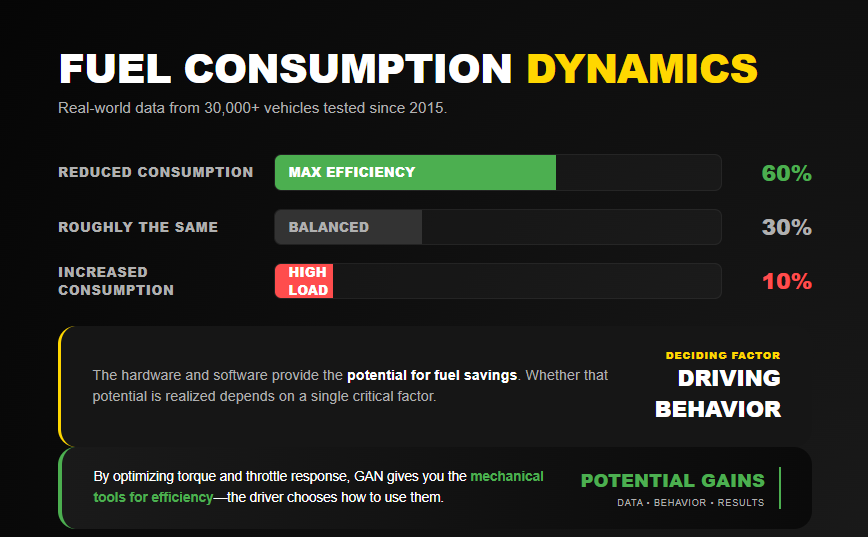
GAN’s data from testing over 30,000 vehicles since 2015 shows the split clearly: about 60% of drivers see reduced fuel consumption, 30% see roughly the same, and 10% see an increase. The difference comes down entirely to driving behavior.
How GAN GA+ Works on Naturally Aspirated Engines
Naturally aspirated engines — no turbo, no supercharger — use the GAN GA+ module. This module pushes your ECU toward more aggressive fuel maps, the kind manufacturers program for performance driving but restrict access to from the factory.
What changes: the air-fuel mixture gets optimized, ignition timing advances, and throttle response sharpens. You get up to 12% more power without any mechanical modifications.
Here’s the interesting part: GA+ includes an eco-mode that leans out the fuel mixture slightly while increasing air intake. This mode puts fuel economy ahead of performance. Drivers running eco-mode see fuel savings up to 15%, which is significant for anyone doing a lot of Interstate driving or running a commercial vehicle.
The caveat: GAN’s primary goal is increasing power. Fuel efficiency is a side benefit, not the main event. If maximum fuel savings is the priority, stick to eco-mode and keep your foot out of it.
How GAN GT Works on Turbocharged Engines
Turbocharged engines use the GAN GT module, which operates differently. Instead of modifying the fuel mixture directly, it intercepts boost pressure sensors on gasoline engines or fuel rail pressure sensors on diesel engines.
Here’s how it works: GT reads the sensor showing, say, 1.5 bar of boost pressure. It modifies that signal down to 1.3 bar before passing it to the ECU. The ECU thinks boost is low and requests more. Actual boost climbs to 1.8 bar. More air plus more fuel equals up to 30% more power.
GAN keeps these modifications within safe mechanical limits. Your turbocharger can handle the added pressure — manufacturers just chose not to run it there. If something goes wrong and limits get pushed past safe territory, your check engine light will flag it. The factory ECU’s protection systems stay fully active throughout.
Fuel consumption on turbocharged engines with GT:
- Highway driving at steady speeds: 10–15% reduction possible
- Mixed city/highway driving: 5–10% reduction typical
- Aggressive driving using full power: 5–15% increase likely
Turbo-diesel drivers see the best results because diesels already run lean fuel mixtures, and the added torque at low RPMs makes highway cruising significantly more efficient.
| Driving Scenario | Naturally Aspirated + GA+ | Turbocharged + GT |
| Conservative highway | -10% to -15% | -10% to -15% |
| Mixed driving (eco-mode) | -5% to -10% | -8% to -12% |
| Mixed driving (sport mode) | 0% to -5% | -3% to -7% |
| Aggressive driving | +5% to +10% | +5% to +15% |
These numbers come from GAN’s testing across 8 countries with different fuel grades, climates, and driving conditions.
Why City Driving Makes Fuel Consumption Unpredictable
Trying to accurately measure fuel economy in city driving is basically a dead end. Too many variables throw off the numbers.
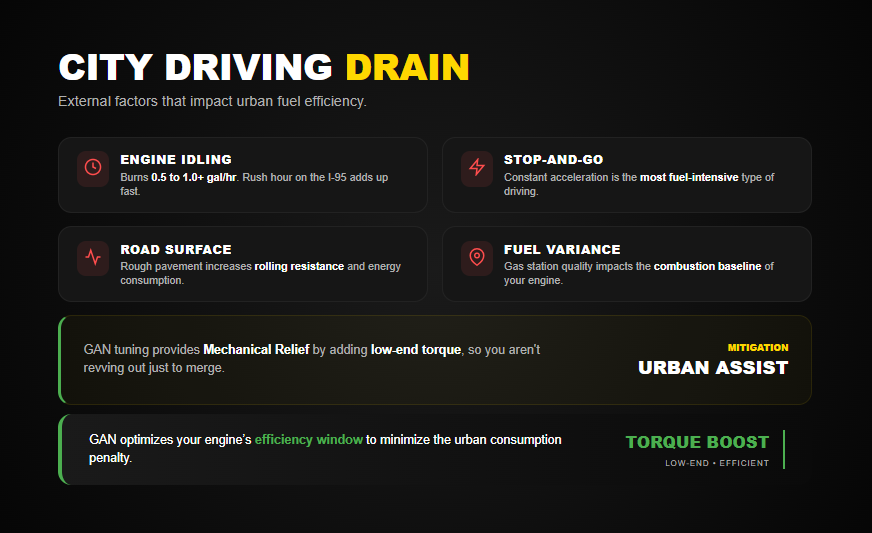
Stop-and-go traffic means constant acceleration and braking — the most fuel-intensive driving you can do. Road surface quality matters (rough pavement means more rolling resistance). Fuel quality varies between gas stations more than most people realize. And sitting in traffic with the AC running burns anywhere from half a gallon to over a gallon per hour depending on engine size, which adds up fast during rush hour on the 405 or I-95.
A tuning module helps somewhat by sharpening throttle response and adding low-end torque, so you’re not revving out just to merge onto a surface street. But city driving will always be fuel-hungry, tuning or not.
Can I actually save money on gas with a tuning module?
If you drive conservatively and use eco-mode, yes. Commercial drivers running diesel vans on highways see the biggest savings — up to 15% reduction over thousands of miles. That adds up fast on a fleet. But if you’re regularly using the extra power, you’ll spend more on fuel than you save.
Does the extra power mean I’m always burning more fuel, even at idle?
No. At idle and light throttle, fuel consumption is basically unchanged. The module only requests more fuel when you’re actually using the added power. Cruise at 65 mph on the highway in the same gear as before, and you’re using the same or slightly less fuel because of the improved torque curve.
Winter Driving Makes Everything Worse
Winter is rough on fuel economy, tuning module or not. Your car burns extra fuel for several reasons that have nothing to do with chip tuning.
Cold starts require rich fuel mixtures to get the engine running. Warming up to operating temperature means combustion isn’t running efficiently yet. Running the heater, defroster, heated seats, and headlights constantly draws power the alternator has to replace — which loads the engine.
Winter tires carry higher rolling resistance than all-seasons or summer tires. Cold, dense air increases aerodynamic drag. Snow and ice on the roads add more resistance. Everything is working against you from November through March.
GAN modules help somewhat by optimizing combustion and torque delivery, potentially saving around 1–1.5 liters per tank in winter conditions. But winter fuel economy will always trail summer numbers, chip or no chip.
The Acceleration Paradox: More Power Can Mean Less Fuel
This one seems backwards, but it’s true. Acceleration is when your engine burns the most fuel. The longer you spend getting up to speed, the more fuel you burn total.
With a tuning module, you’ve got 20–30% more torque throughout the power band. That means you reach highway speed faster and spend less total time in the high-consumption acceleration phase. You might burn slightly more fuel per second during that acceleration window, but the shorter duration means less total fuel used.
This is especially noticeable on highways with long on-ramps or through hilly terrain. Before tuning: you drop to fourth gear, wind it up to 4,000 RPM, spend 15 seconds getting up to speed. After tuning: you stay in fifth gear, pull from 3,000 RPM, reach speed in 8 seconds. The second scenario burns less fuel overall.
Turbo-diesel drivers notice this most clearly. The added torque at low RPMs means they rarely need to downshift, which keeps the engine in its most efficient operating range mile after mile.
What Actually Happens After Installing a GAN Module
Based on real-world data from 30,000+ vehicles tested since 2015, here’s the typical pattern:
You’ll feel an immediate power increase — 20–30% on turbocharged engines, 10–12% on naturally aspirated. Throttle response sharpens noticeably. The engine pulls harder from lower RPMs.
Fuel consumption in the first few weeks usually ticks up slightly because you’re exploring the new power. That’s normal. After the novelty settles and you return to your regular driving routine, fuel consumption typically drops below your pre-tuning baseline.
The improved torque curve means fewer downshifts, less time at high RPM, and more efficient highway cruising. Use eco-mode and drive with a light foot, and you’ll see the maximum fuel savings. Use sport mode and drive hard, and you’ll burn more gas — but that’s a choice, not an unavoidable side effect of tuning.
Engineers with over 20 years of calibration experience built these modules to improve both power and efficiency simultaneously. The technology supports both outcomes — which one you get depends on your right foot.
Articoli utili sul chip tuning:
You’ve probably seen comments online claiming tuning boxes are scams. The argument usually goes something like this: “There’s nothing technically complex about these boxes. They just alter sensor signals. Zero innovation. No feedback. Pure deception.” Sounds pretty damning, right? Except the people making these claims are usually OBD tuning shops trying to sell you ECU […]
Your car’s ECU is basically a small computer that runs your engine. That’s it. Everything else — all the power increases, fuel mapping, sensor reading — flows from that one fact. Understanding what an ECU actually does makes it way easier to understand how chip tuning works and why it’s even possible. So let’s break […]
Want more power from your car? There are basically two ways to do it: plug in an additional control unit, or mess with your factory ECU software. One of these keeps your warranty. The other one doesn’t. Here’s a breakdown of what actually happens with each method, because there’s a lot of noise out there […]


Contact us via WhatsApp