


Want more power from your car? There are basically two ways to do it: plug in an additional control unit, or mess with your factory ECU software. One of these keeps your warranty. The other one doesn’t.
Here’s a breakdown of what actually happens with each method, because there’s a lot of noise out there and most of it gets the details wrong.
The Two Main Ways to Boost Engine Power
Chip tuning modifies your vehicle’s electronics to increase speed and power. Sometimes — like with commercial trucks or farm equipment — the goal is cutting fuel consumption instead. But for most drivers, it’s about getting more punch when you put your foot down.
Method 1: Additional control unit (external chip) You install a separate device that sits between your engine sensors and the factory ECU. Nothing gets permanently changed.
Method 2: OBD tuning (ECU remapping) A technician rewrites your factory ECU software through the diagnostic port. Your original programming gets replaced.
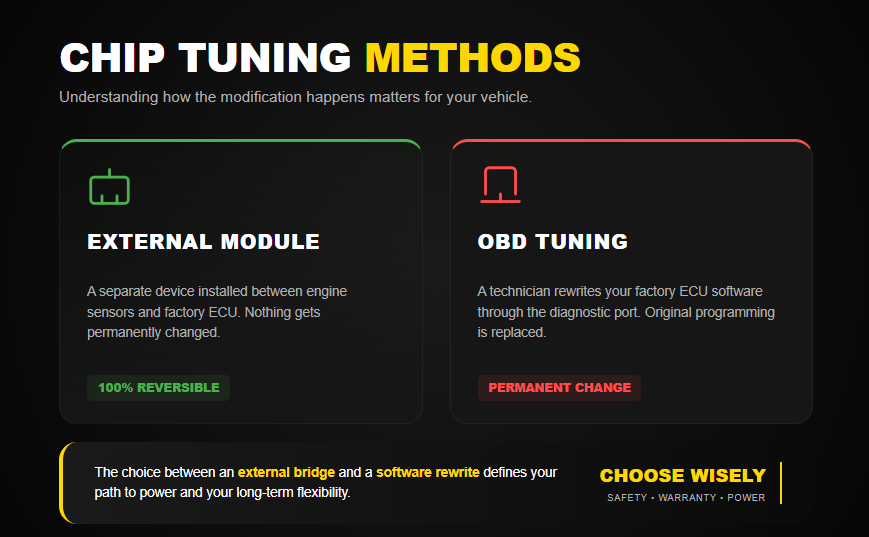
The difference matters a lot more than most people realize.
How Additional Control Units Work
An external tuning chip connects to your engine and communicates with your factory ECU. No cutting wires, no cracking open the ECU itself. The chip reads signals from engine sensors — things like air pressure, temperature, and fuel flow — and adjusts them in real time before they reach your factory computer.
What’s happening under the hood: the chip tweaks fuel injection timing, turbo boost pressure, and ignition advance. Your engine produces more power and torque without crossing into dangerous territory.
Here’s the part that actually matters: your engine’s protective programs stay fully active. The factory ECU still monitors everything and will pull power back if something goes wrong. Your original software? Completely untouched. Take the chip out before a service appointment and your dealer has no idea it was ever there.
Real-world performance from GAN modules, tested on 30,000+ vehicles:
| Engine Type | Power Gain | Torque Gain | Fuel Economy Change |
| Turbocharged gasoline | Up to +30% | Up to +30% | Up to +15% better |
| Naturally aspirated | Up to +12% | Up to +15% | Up to +10% better |
| Diesel | Up to +30% | Up to +35% | Up to +15% better |
Installation takes 10–15 minutes. You plug it in and drive.
What OBD Tuning Actually Does
OBD tuning accesses your factory software through the diagnostic port. The technician pulls the program from your ECU or flash memory, edits it on a laptop with specialized software, then writes the modified version back to your ECU.
Some things OBD tuning can do that external chips can’t: remove the factory speed limiter completely, optimize for heavily modified engines with bigger turbos or upgraded injectors, and sometimes squeeze out 2–3% more power at the absolute top end.
Sounds good, right? Hold on.
The Problems Nobody Mentions About OBD Tuning
Most OBD tuning disables or modifies your engine’s safety systems. Why? Because those systems limit power to protect components. Remove the limits, get more power — but also remove the safety net.
Bypassing security on modern ECUs is where things get genuinely risky. These are fragile electronics. One wrong move during the flash and your ECU can brick. Your car won’t start. Or worse — it runs fine for a few weeks, then fails out of nowhere on the highway.
Engineers with over 20 years in engine calibration are consistent on this point: the biggest risk isn’t the tune itself, it’s corrupted ECU software during the flashing process.
And here’s something tuners don’t advertise: automakers have gotten smart about this. Most brands now include anti-tuning detection in their diagnostic systems. The factory software has specific markers baked in. Change the software, and those markers disappear. When you roll in for warranty service, the dealer plugs in their diagnostic tool and immediately sees your ECU has been modified. Warranty gone.
Real risks with OBD tuning:
- Engine protection systems disabled or reduced
- High risk of ECU damage during flashing — can show up weeks later
- Warranty automatically void — dealers can detect the changes
- No way back once the flash goes wrong
Which Method Actually Makes Sense for Most People?
Look, if you’re building a track car with thousands of dollars in engine modifications, OBD tuning might make sense. You’re already way past caring about the factory warranty.
For everyone else? External control units are the smarter call. GAN has been doing this since 2015 across 8 countries, and what they’ve learned is pretty straightforward.

Why GAN recommends external chips over ECU flashing:
Your warranty stays intact. The chip is plug-and-play — connect it, drive it, pull it out before dealer visits. It leaves zero mechanical or electronic traces. Your service tech literally cannot tell it was there.
Safety is built in. GAN backs their modules with an additional 2-year engine warranty up to €5,000. They wouldn’t offer that if the modules were putting engines at risk.
You get 5 free reprogramming sessions. Switching cars? Just reprogram the same chip for your new vehicle. You might need a different sensor cable, but the chip itself works across different makes and models.
Smartphone control changes the game. Pick Sport mode for maximum power, Dynamic for balanced performance, ECO when you want better efficiency, or Stock to disable the chip completely. There are 18 fine-tuning modes if you want to dial things in precisely.
The 50-day test drive eliminates risk. Run the chip for nearly two months on your daily driver. Don’t like it? Changed your mind? Return it within 50 days for a full refund, no questions.
Will chip tuning damage my engine over time?
External chips from GAN operate within manufacturer-safe parameters and keep all factory protection systems active. That’s exactly why they can back it with a €5,000 engine guarantee for 2 years. OBD tuning often disables those same protections — that’s where engine damage risk comes from.
Can I install a chip tuning module myself?
Most people do it themselves. Find your OBD-II port or the specific sensor connections shown in your owner’s manual, plug in the module following the 15-minute setup guide, and download the app. No special tools, no shop visit. If you can plug in a phone charger, you can install a tuning chip.
The Bottom Line on Power Increases
OBD tuning gets you maybe 2–3% more power at the extreme top end. In return, you lose your warranty, risk bricking your ECU, and disable the safety systems protecting your engine. External chips deliver up to 30% on turbocharged engines, keep your warranty valid, and unplug in seconds with zero trace left behind.
For most American drivers, that’s not a close decision.
You can calculate your specific car’s potential power increase on GAN’s website. Just enter your make, model, and engine — takes about 30 seconds.
Articoli utili sul chip tuning:
Your car’s ECU is basically a small computer that runs your engine. That’s it. Everything else — all the power increases, fuel mapping, sensor reading — flows from that one fact. Understanding what an ECU actually does makes it way easier to understand how chip tuning works and why it’s even possible. So let’s break […]
You want more power from your car. Fair enough. There are basically two ways to get it: mechanical modifications or electronic tuning. One costs thousands and takes weeks. The other costs hundreds and takes 15 minutes. Let me explain what each method actually involves and what you can realistically expect. What “tuning” actually means Tuning […]

Your car’s engine isn’t running at full capacity. Never has been. Manufacturers deliberately program engines to produce less power than they’re actually capable of, and there are some very specific reasons why. This isn’t a conspiracy theory — it’s basic automotive economics and engineering. Here’s what’s actually going on under the hood. What Actually Happens […]


Contact us via WhatsApp