


Your car’s engine isn’t running at full capacity. Never has been. Manufacturers deliberately program engines to produce less power than they’re actually capable of, and there are some very specific reasons why.
This isn’t a conspiracy theory — it’s basic automotive economics and engineering. Here’s what’s actually going on under the hood.
What Actually Happens During Chip Tuning
Modern cars are packed with sensors. Coolant temperature, air pressure, throttle position, oxygen levels — dozens of them feeding data to your ECU every millisecond. The ECU takes all that information and decides how much fuel to inject, when to fire the spark plugs, how much boost pressure to allow.
Chip tuning intercepts signals between these sensors and the ECU. A tuning module reads the sensor data, modifies it based on what your engine can actually handle — not what the factory decided to cap it at — then sends the adjusted information to the ECU.
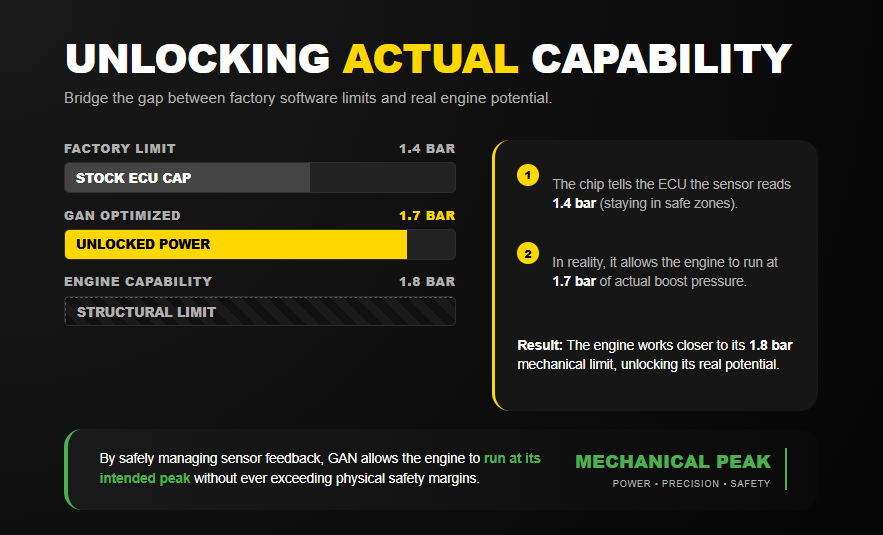
Think of it this way: your engine could handle running at 1.8 bar of boost pressure, but the factory programmed the ECU to max out at 1.4 bar. A tuning chip tells the ECU “the sensor is reading 1.4 bar” when it’s actually allowing 1.7 bar. The engine produces more power because it’s finally running closer to its real capability.
Why Manufacturers Leave Power on the Table
Automakers could absolutely tune engines to maximum power straight off the assembly line. They choose not to. Here’s why.
Global market regulations are a headache. One engine has to work in Germany where drivers cruise the Autobahn at 130 mph, and also in countries with low-grade fuel and inconsistent maintenance habits. Same engine, completely different operating conditions. Conservative limits mean the engine survives everywhere.
Insurance and emissions rules vary by state and country. A 200-horsepower car might fall into one insurance bracket in one market, while a 220-horsepower version of the exact same car jumps to a higher one. Manufacturers create different power versions by simply changing software. Same hardware, different ECU maps, different price tags.
Maintenance intervals affect buyer satisfaction. Program the engine to run at peak output constantly and you’re looking at oil changes every 3,000 miles instead of 10,000. Most buyers care more about low running costs than maximum performance — and automakers know their customer surveys.
Model differentiation is pure business strategy. Mercedes C 200 CDI versus C 220 CDI? Same exact engine. The only difference is ECU programming. One makes 136 horsepower, the other makes 170. Mercedes charges you $3,000+ for software.
Look at Volkswagen’s 2.0 TDI diesel. You’ll find the identical engine in the VW T5, Skoda Superb, VW Passat CC, and Audi A6. Same block, same internals. But power output ranges from 140 horsepower to 177 horsepower depending on the badge up front. That’s ECU programming building an entire model lineup out of one engine.
| Vehicle Model | Engine | Factory Power | Factory Torque | Actual Capability |
| VW T5 | 2.0 TDI | 140 HP | 340 Nm | Up to 180 HP / 440 Nm |
| Skoda Superb | 2.0 TDI | 140 HP | 320 Nm | Up to 180 HP / 440 Nm |
| VW Passat CC | 2.0 TDI | 170 HP | 350 Nm | Up to 220 HP / 450 Nm |
| Audi A6 | 2.0 TDI | 177 HP | 380 Nm | Up to 230 HP / 480 Nm |
GAN’s testing on over 30,000 vehicles confirms these engines handle the higher numbers comfortably with proper tuning.
The Engineering Reasons Behind Conservative Factory Tunes
Manufacturers build in protection against what they call “abuse scenarios.” Someone buys a turbocharged car, never lets it warm up, floors it cold on the on-ramp every morning, runs cheap gas, skips oil changes for two years. The engine still has to survive all of that under warranty.
Factory ECU programming includes massive safety margins. If the engine could theoretically handle 400 Nm of torque continuously, manufacturers might cap it at 320 Nm just to cover worst-case situations that most drivers will never actually hit.
Climate adaptation plays into it too. Engines behave differently at -20°F in Minnesota versus 115°F in Phoenix. Rather than engineer region-specific tunes — expensive and logistically complicated — manufacturers program one conservative map that holds up everywhere.
Engineers with over 20 years of calibration experience are consistent on this point: modern engines are massively over-built relative to their factory power outputs. A turbocharger rated for 2.2 bar might be limited to 1.5 bar from the factory. Fuel injectors capable of 2000 bar get capped at 1600 bar. The hardware can handle significantly more than the software allows.
Why Four-Cylinder Cars Don’t Outperform Six-Cylinder Models
This one’s purely about not cannibalizing your own lineup. BMW’s 2.0-liter turbocharged four-cylinder could easily be tuned to match their 3.0-liter six in power. The turbo four is actually more efficient and lighter.
So why doesn’t BMW do it? Because then nobody would buy the more expensive six-cylinder models. The product planning team won’t allow it.
Same story across every manufacturer. The hardware gap between engine tiers keeps shrinking, but the software gap is what maintains the price ladder. That’s where chip tuning gets interesting — you’re buying the base trim and unlocking performance that the manufacturer deliberately restricted to protect sales of the next model up.
If manufacturers limit power, why don’t they just stop chip tuning?
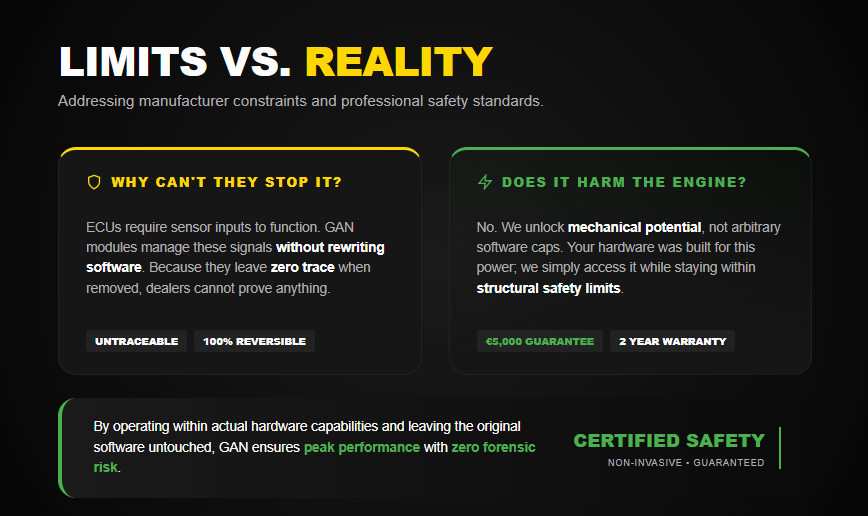
They can’t, without making the car undriveable. The ECU needs sensor inputs to function — that’s non-negotiable. Any device that modifies those inputs will work. Some manufacturers tried anti-tuning detection in their diagnostic systems, but external modules like GAN’s leave zero trace when removed. Dealers can’t prove anything.
Does unlocking factory-limited power harm the engine?
Not when it’s done properly. GAN modules stay within the engine’s actual mechanical limits — not the arbitrary software limits the factory chose. That’s why they can back it with a €5,000 engine guarantee for 2 years. The hardware was built to handle more power. Manufacturers just chose not to use it.
How Chip Tuning Companies Fill the Gap Manufacturers Created
The chip tuning industry exists entirely because manufacturers deliberately undertune engines. If cars rolled off the line running at their mechanical limits, there’d be nothing to unlock.
GAN has been doing this since 2015 across 8 countries, and the pattern holds consistently: turbocharged engines typically have 25–35% power headroom built into the hardware, while naturally aspirated engines carry 10–15% headroom. Manufacturers use roughly 70–80% of available capability.
Real gains from unlocking factory restrictions, tested on 30,000+ vehicles:
- Turbocharged gasoline engines: up to +30% power, up to +30% torque
- Turbocharged diesel engines: up to +30% power, up to +35% torque
- Naturally aspirated engines: up to +12% power, up to +15% torque
The gap between turbocharged and naturally aspirated gains comes down to how manufacturers treat turbos. Because they’re easier to damage if neglected, manufacturers restrict them more aggressively — which means more headroom for proper tuning to recover.
The Bottom Line on Manufacturer Restrictions
Automakers program engines conservatively for legitimate reasons — global markets, warranty costs, model differentiation, maintenance intervals. But that conservatism leaves a real amount of performance sitting unused in your engine every time you drive.
Chip tuning works because it removes arbitrary software limits while respecting the actual mechanical limits of your hardware. You’re not pushing the engine past what it was built to handle. You’re using what was always there.
Manufacturers know this better than anyone. They do the exact same thing when they package a “sport” trim or performance package — they just charge you a lot more for the privilege.
Articoli utili sul chip tuning:

Here’s something most drivers never think about. Back in the ’80s, squeezing more power out of your car meant pulling apart the ECU, desoldering chips with a heat gun, and hoping you didn’t turn your engine computer into a very expensive paperweight. Jump to 2026, and you’ve got plug-and-play modules adding 30% to turbocharged engines. […]

Turbo-diesel engines respond to chip tuning better than any other engine type. You can see gains up to 30% power and 35% torque — significantly more than naturally aspirated or even turbocharged gasoline engines. Why? The way turbo-diesels work makes them particularly well-suited for tuning. Let me explain what’s actually happening. Quick history: how turbo-diesels […]
Naturally aspirated engines gain less from chip tuning than turbocharged engines. That’s just physics. You’ll see around 10–12% power increase, maybe 15% torque increase at best. But that 10–12% is still worth having. Let me explain what’s actually possible with naturally aspirated engines and why the gains are limited compared to turbocharged motors. What makes […]


Contact us via WhatsApp