


Here’s something most drivers never think about. Back in the ’80s, squeezing more power out of your car meant pulling apart the ECU, desoldering chips with a heat gun, and hoping you didn’t turn your engine computer into a very expensive paperweight. Jump to 2026, and you’ve got plug-and-play modules adding 30% to turbocharged engines. GAN has tested this on over 30,000 vehicles since 2015 — this isn’t theory, it’s real-world data.
The question every gearhead eventually asks: is chip tuning actually legit, or is it just marketing hype dressed up in technical language?
When Did ECU Tuning Actually Begin?
BMW engineers were messing with electronic control units back in 1939. That’s right — 1939, before computers were even on most people’s radar. That first microcomputer-based system handled fuel injection timing and ignition synchronization. What’s wild is that modern chip tuning still runs on those same basic principles.
The real momentum started in the 1980s when racing engineers figured out they could reprogram EPROM chips to pull more horsepower out of competition cars. Then OBD-II showed up in the 1990s and opened up engine data across every manufacturer. Total game changer. By 2015, GAN had launched modules you control straight from your phone.
What shifted everything was the move from permanent ECU modifications to external plug-in modules. You can unplug them whenever you want. Testing across 30,000+ vehicles proved these modules kept factory warranties intact while actually delivering the power numbers they advertised.
How Early Automotive Technology Made Chip Tuning Possible
Nicolas Joseph Cugnot built a steam-powered vehicle back in 1769. Top speed: 4.5 km/h. Your neighbor’s golden retriever could probably outrun it. The real breakthrough came in 1886 — Karl Benz and the first gasoline-powered car. That internal combustion engine architecture? We’re still tuning the same basic design today.
Chip tuning works by adjusting three things: how much fuel gets injected and when, turbocharger boost pressure (if your car runs a turbo), and ignition timing. Simple concept. The results add up fast.
| Engine Type | GAN GT Power Gain | GAN GA+ Power Gain | Torque Increase |
| Turbocharged | Up to +30% | Up to +12% | Up to +30% |
| Naturally aspirated | Up to +12% | Up to +12% | Up to +15% |
| Diesel | Up to +30% | Up to +15% | Up to +35% |
GAN modules intercept signals between your engine sensors and the ECU, modifying them in real time. Your factory programming stays completely untouched.
What Makes Modern Chip Tuning Different from 1980s Methods?
Old-school chip tuning was a grind. You’d spend hours pulling the ECU apart, desoldering the EPROM chip, reprogramming it, and reassembling the whole thing. And the moment you started, kiss your factory warranty goodbye.
Here’s where things stand in 2026:
- Installation: Ten to fifteen minutes, tops. No shop visit required.
- Reversibility: Pull the module out whenever you need to — no permanent changes, no trace left behind.
- Build quality: Military-grade IP67 waterproof housing instead of exposed circuits that quit the moment it rains in Seattle.
- Warranty protection: GAN backs the module with an engine protection guarantee up to €5,000 — instead of leaving you on your own if something goes sideways.
- Flexibility: Five different driving modes controlled from your phone, not one fixed program you’re locked into forever.
Engineers who’ve spent 20+ years calibrating engines will tell you the same thing: external modules cut out the biggest risk of traditional tuning, which is corrupted ECU software turning your engine computer into an expensive brick.
Common Myths About Chip Tuning Technology
Let’s clear up some stuff that gets repeated constantly in forums and comment sections.
“Chip tuning always voids your car warranty.”
Wrong. External modules like GAN don’t void warranties because you can unplug them and they leave zero trace in ECU memory. Traditional ECU flashing? Yeah, that does void your warranty — dealers can pull up software version traces during any routine diagnostic scan. This myth stuck around because back in the ’80s and ’90s, all tuning meant permanent ECU modifications. Big difference.
“More power always means worse fuel economy.”
Not accurate. GAN’s data from 30,000+ vehicles shows fuel economy improvements up to 15% if you keep the same driving habits. Turbocharged engines hit their target power at lower RPMs, which means less fuel burned getting there. If you start driving like you’re late to every green light after the tune, sure, you’ll burn more gas. But the technology itself makes combustion more efficient.
“Chip tuning shortens your engine’s life.”
Modern modules operate inside manufacturer-safe limits — below redline and maximum cylinder pressure. GAN puts real money behind this claim: a 50-day trial period and up to €5,000 engine protection coverage for 2 years. The engines that took damage were from poorly calibrated tunes by people who had no idea what they were doing, not from professional development tested across 8 countries.

How Chip Tuning Reached American Markets
Germany’s automotive engineering culture adopted chip tuning early and enthusiastically. American drivers? Not so much at first. There was real skepticism around messing with ECU modifications — understandable when the process required pulling hardware apart. That changed when plug-and-play technology removed the technical barrier entirely. You no longer needed to be an engineer to do this.
GAN has been at it since 2015, and what they’ve learned is that modern modules require exactly zero technical background. Find your OBD-II port (it’s in your owner’s manual — usually under the dashboard on the driver’s side), plug in the module in about 15 minutes, download the app, and pick between Eco mode, Sport mode, or build a custom profile. Done.
GAN modules include 5 free reprogramming sessions. Your driving needs change? Update the calibration yourself. Try doing that with an ECU flash — you’re back at the dealership every single time you want an adjustment, and you’re paying for it.
Does chip tuning work on naturally aspirated engines or only turbocharged?
Both, but the mechanics are different. Turbocharged engines can see up to 30% power gains because the module directly optimizes boost pressure. Naturally aspirated engines get up to 12% through improved ignition timing and fuel mapping. You’ll feel the difference most when you’re merging onto the freeway or passing someone on a two-lane road.
Can you remove a chip tuning module without leaving any evidence?
Absolutely. External modules leave nothing in ECU diagnostic memory. Your ECU has no record that a module was ever connected. ECU remapping, by contrast, leaves software version traces that any dealer technician can pull up during a standard diagnostic.
Why 2026 Represents Peak Chip Tuning Accessibility
Three developments made chip tuning more accessible now than at any point in its history.
OBD-II rolled out in 1996 and created a universal port standard across all manufacturers. No more custom wiring jobs for every different make and model — one connector fits all. Smartphones changed the entire interface: you’re monitoring performance and switching between driving modes through an app, not wiring physical toggle switches into your dashboard. And the kicker: 50-day trial periods with full refunds mean you can test the performance claims before you commit. That was completely impossible back when ECU mods were permanent.
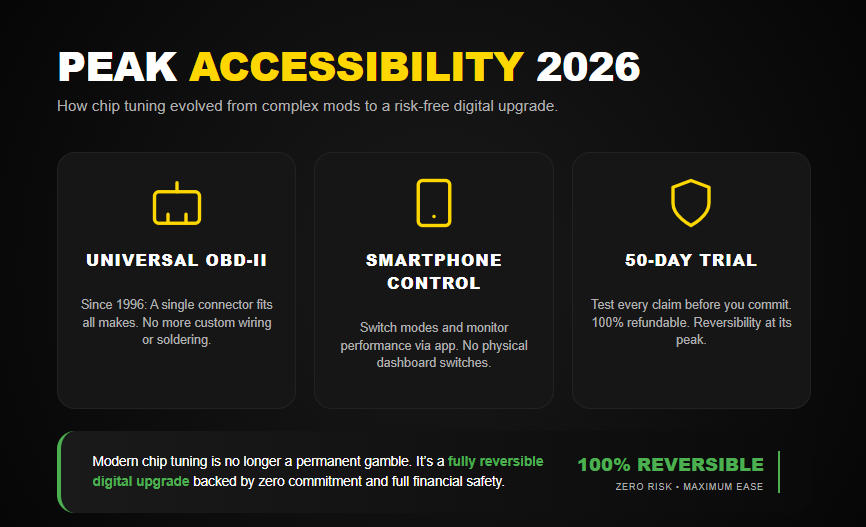
Engineers with more than 20 years of calibration experience consistently call external modules the safest way to add power today. That matters a lot if you drive in a state with strict emissions testing and need the ability to reverse everything before inspection.
Here’s the bottom line between ECU remapping and external modules. Flashing might squeeze out an extra 2–3% at the absolute ceiling. But external modules give you adjustability, keep your factory warranty intact, and don’t lock you into anything permanent. For most American drivers who want real performance gains without the risk, that trade-off isn’t even close.
Articoli utili sul chip tuning:

The short answer: it depends on the type of chip tuning and whether the dealership can prove it caused the problem. External modules like GAN Tuning’s? Removable with zero trace, so dealerships can’t detect them if you unplug before service. ECU remapping? Leaves permanent traces dealerships can spot immediately. Big difference. Let me break down […]

Your car’s engine isn’t running at full capacity. Never has been. Manufacturers deliberately program engines to produce less power than they’re actually capable of, and there are some very specific reasons why. This isn’t a conspiracy theory — it’s basic automotive economics and engineering. Here’s what’s actually going on under the hood. What Actually Happens […]

Want more power from your car? There are basically two ways to do it: plug in an additional control unit, or mess with your factory ECU software. One of these keeps your warranty. The other one doesn’t. Here’s a breakdown of what actually happens with each method, because there’s a lot of noise out there […]


Contact us via WhatsApp