





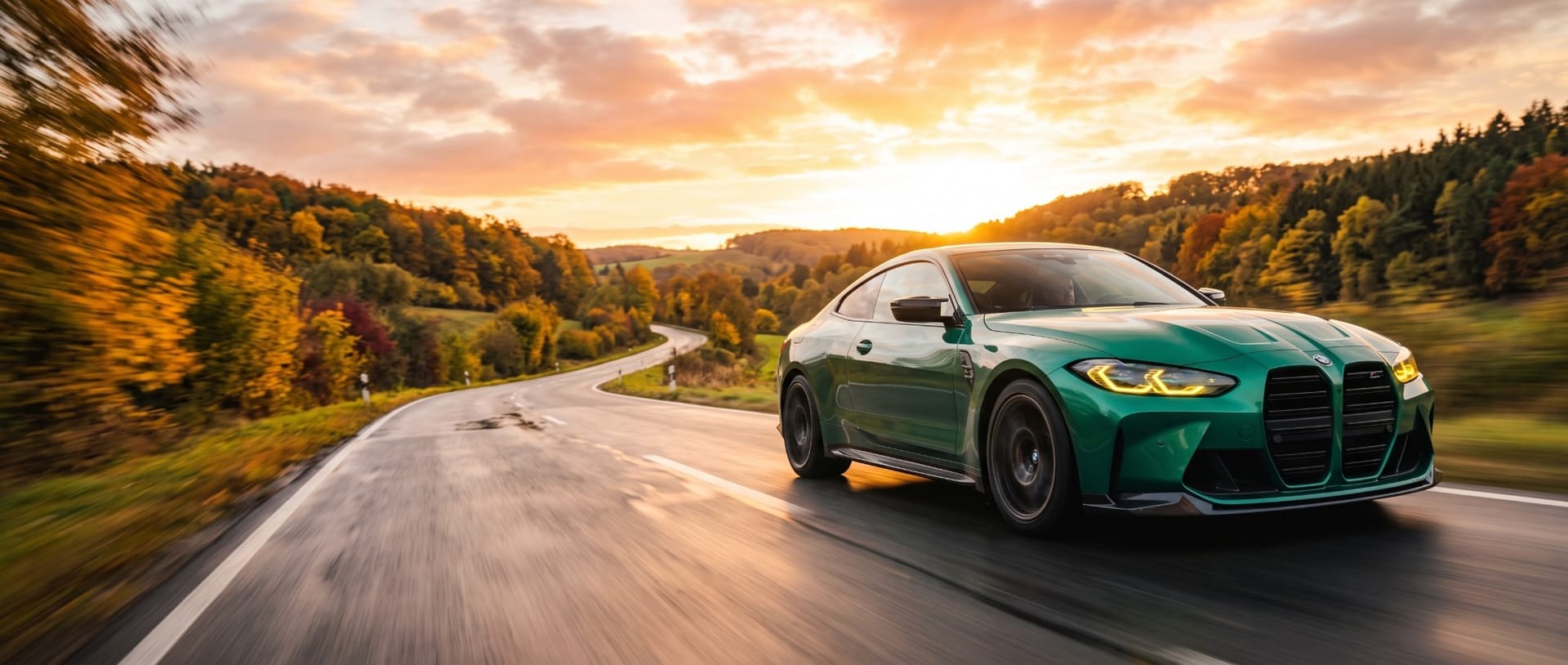
Performance Chip Tuning BMW
Up to 30% more power for your BMW
The BMW catalog lists 583 engines (models: 23, generations: 65). For 77% of the engines, there are the GAN GT (up to 30% more power) and GAN GTL (up to 25%) tuning modules; for the rest, the GAN GA and GAN GA+ (up to 12%). Each engine’s figures are on its own page.
BMW performance chip: more power, no ECU flash
The GAN module sits between the sensors and the engine control unit (ECU) and adjusts their signals. Unlike a flash tuner, it doesn’t rewrite your ECU software: your factory warranty is preserved, and the module can be removed at any time.
- Bluetoothswitch modes from your phone
- 18 mapsto fine-tune your engine
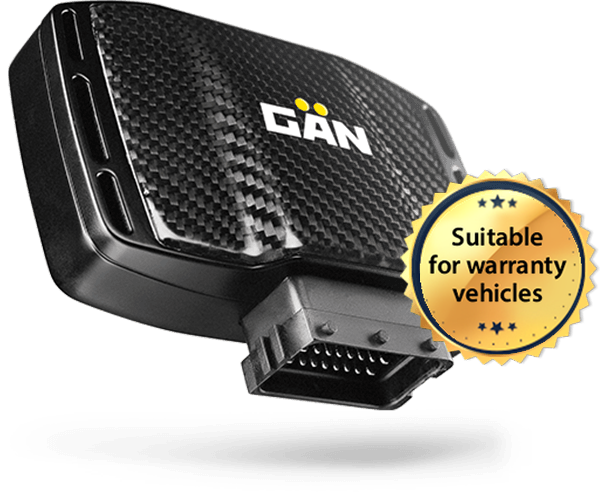
- 15 minutesplug-and-play install
- IP67water and dust protection
- up to +30%more power with the GAN GT
Turbo engines pick up +24 to +106 hp, depending on the engine.
- up to +12%for naturally aspirated engines with the GAN GA+
GAN GA and GAN GA+ tuning modules for 134 naturally aspirated engines from BMW; see the catalog for each engine’s figure.
- GAN APPpower control via smartphone
Switch between SPORT, DYNAMIC, ECO and STOCK in the GAN app.
- 50 daystest drive
Enhanced performance or your money back, excluding shipping costs.
Choose your BMW model
Each model lists its generations: one click gets you to a generation, two to an engine.
The biggest BMW gains
The six engines with the biggest gains in our catalog. These are the top of the range, not typical figures.
| Model · generation | Engine | Fuel | STOCK | With GAN | Gain | Tuners and prices |
|---|---|---|---|---|---|---|
| M5 M5 (F10) 2010-16 | 4.4 | Gasoline | 600 hp / 700 Nm | 706 hp / 836 Nm | +106 hp | GTL from 379 EUR GT from 519 EUR |
| M6 M6 (F13) 2012-17 | 4.4 | Gasoline | 600 hp / 700 Nm | 706 hp / 836 Nm | +106 hp | GTL from 379 EUR GT from 519 EUR |
| M5 M5 (F10) 2010-16 | 4.4 V8 Competition | Gasoline | 575 hp / 680 Nm | 677 hp / 825 Nm | +102 hp | GTL from 379 EUR GT from 519 EUR |
| M6 M6 (F13) 2012-17 | 4.4 V8 Competition | Gasoline | 575 hp / 680 Nm | 677 hp / 825 Nm | +102 hp | GTL from 379 EUR GT from 519 EUR |
| M5 M5 (F10) 2010-16 | 4.4 V8 | Gasoline | 560 hp / 680 Nm | 660 hp / 825 Nm | +100 hp | GTL from 379 EUR GT from 519 EUR |
| M6 M6 (F13) 2012-17 | 4.4 V8 | Gasoline | 560 hp / 680 Nm | 660 hp / 825 Nm | +100 hp | GTL from 379 EUR GT from 519 EUR |
What BMW owners say about GAN
After first minutes of using, the engine thrust increased, I can notice a better response of the acceleration pedal, and the fuel consumption decreased (about a liter) . At this moment everything is perfect.
BMW tuning FAQ
BMW plug-in module or flash tune: what stays untouched?
A flash tune swaps out the factory software in the engine control unit (ECU). The GAN module works between the engine sensors and the ECU and adjusts their signals. The factory software, checksums and flash counter stay untouched. The ECU software is never changed, so your factory warranty is preserved, and you can remove the module at any time.
BMW 340i tuner: what should I check before I install one?
Check the mechanics first: a performance chip adjusts sensor signals and never touches a part like the timing chain. The B58 and N20 are both turbocharged and take the GAN GT, so find your 340i or other turbo BMW by its hp figure on the model page. For example, the European N47 diesel (116d to 123d, 318d to 325d and others) has a known weak spot: the timing chain on the transmission side. A check or replacement is recommended from around 100 thousand km, and a rattle is the warning sign. Engines built between March 1, 2007 and January 5, 2009 are the most affected, though cases are known on diesels up to 2015.
Does the GAN performance chip cover the B48 and B58 in the F and G generations?
The B48 is a 2.0-liter four and the B58 a 3.0-liter six. Both belong to the turbocharged B family that replaced the N series. Turbo engines mostly take the GAN GT. Look up your engine by generation and hp on its model page.
What can a performance chip do for a naturally aspirated N52 or N53 six?
Both are naturally aspirated sixes. The N52 dates from 2004, and the N53 was built from 2006 to 2013. On these engines the GAN GA+ is rated at up to 12% more power, and that is a ceiling, not a promise. For a 218 hp engine, that works out to 26 hp more at most.
Does the GAN module affect my BMW factory warranty?
No. The module doesn’t change the ECU software and can be removed at any time, so your factory warranty is preserved. On top of that, GAN gives its own engine warranty: 2 years with the GAN GT, 1 year with the GAN GTL.
Plug-in performance chip or flash tuner: which should I choose?
A flash tuner rewrites the maps in your ECU, and the flash counter records it. The GAN module adjusts the sensor signals instead: the ECU stays in factory condition, and you can return the car to stock in about a minute.
BMW engines: what to know before you tune
BMW tuner basics: the trunk badge no longer tells you the engine size
Before you shop for a BMW tuner, clear up one thing: the number on the trunk lid stopped meaning engine size long ago. The right module is chosen by engine family, not by badge. Those two digits used to be displacement in tenths of a liter, so a 318 had 1.8 liters and a 330 had 3.0. With turbos, the number turned into a power class. The F30 328i and 330i are both 2.0-liter engines.
Letters help too: i means gasoline, d is diesel, e is a plug-in hybrid, and x or xDrive is all-wheel drive. U.S. badges follow the same pattern, like the 330i, M340i, 540i or X5 40i. One badge can also hide several power ratings, and that decides which tune fits. Take the European 116i: 116 hp in the E87 in 2004, 122 hp from 2007, 136 hp in the F20, and 109 hp in the later F20 and the F40.
Your engine family decides the module
BMW groups its engines into families, and the family says more than the badge. Through the 2000s most gasoline engines were naturally aspirated: the four-cylinder N42, N45, N46 and N43, and the six-cylinder N52 and N53. Turbocharging reached BMW's gasoline sixes with the N54 in 2006. The single-turbo N55 followed in 2009, then the four-cylinder N13 and N20 in 2011. From 2014 the modular B38, B48 and B58 took over from the N series, and all three are turbocharged.
The current U.S. 330i is rated at 255 hp from a 2.0-liter turbo four, and the M340i at 386 hp from a 3.0-liter turbo six; in the table the 330i is the 3 Series (G20) 330i row, listed at 258 and 245, metric figures for the same engine, and the M340i has no row yet. Diesels run M47, N47, B47 in four cylinders and M57, N57, B57 in six. In the catalog, turbo engines mostly take the GAN GT, with up to 30% more power. Naturally aspirated gasoline engines take the GAN GA+, with up to 12%.
Read moreShow less
What BMW itself offered for the same engines
BMW once sold its own Performance Power Kit for the N55-powered 135i and 335i. The kit lifted output from 306 to 326 hp and torque from 400 to 430 Nm (295 to 317 lb-ft). M Performance models like the M135i, M140i, M340i and M550d are a separate line from the M GmbH cars: the M3, M4 and M5.
Body codes by BMW model
BMW names its generations by body code. 3 Series: E46 (1998–2006), E90 (2005–2013), F30 (2011–2019), then G20 from 2018. 5 Series: E60 (2003–2010), F10 (2009–2016), G30 (2016–2023), then G60 from 2023. 1 Series: E87 (2004–2013), F20 (2011–2019), F40 (2019–2024).
X3: E83 (2003–2010), F25 (2010–2017), G01 (2017–2024). X5: E53 (1999–2006), E70 (2006–2013), F15 (2013–2018), then G05 from 2018. The 2 Series coupe is the F22 (2013–2021). The 4 Series is the F32 (2013–2020), then the G22 from 2020.
Which BMW models are in the catalog
The catalog lists 23 models from BMW. The most engines are listed for the 3 Series (98), 5 Series (96) and 1 Series (52). The biggest gain among the models is on the M5: up to +106 hp.
Naturally aspirated BMW engines
For 134 naturally aspirated engines from BMW, there’s the GAN GA+: up to 12% more power and up to 15% better fuel economy in ECO mode. It’s plug-and-play: you can install it yourself, in most cases in under 15 minutes.
How to find your BMW engine
Pick your model in the list above, then the generation by model year, and the engine by displacement and horsepower (see your owner’s manual or vehicle documents). The engine page shows the exact gain and the tuner price.