






Performance Chip Tuning Hyundai
Up to 30% more power for your Hyundai
The Hyundai catalog lists 401 engines (models: 49, generations: 79). For 36% of the engines, there are the GAN GT (up to 30% more power) and GAN GTL (up to 25%) tuning modules; for the rest, the GAN GA and GAN GA+ (up to 12%). Each engine’s figures are on its own page.
Hyundai performance chip: more power, no ECU flash
The GAN module sits between the sensors and the engine control unit (ECU) and adjusts their signals. Unlike a flash tuner, it doesn’t rewrite your ECU software: your factory warranty is preserved, and the module can be removed at any time.
- Bluetoothswitch modes from your phone
- 18 mapsto fine-tune your engine
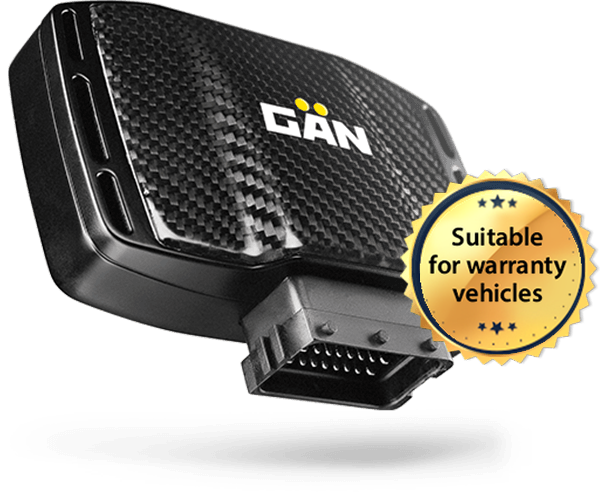
- 15 minutesplug-and-play install
- IP67water and dust protection
- up to +30%more power with the GAN GT
Turbo engines pick up +22 to +67 hp, depending on the engine.
- up to +12%for naturally aspirated engines with the GAN GA+
GAN GA and GAN GA+ tuning modules for 256 naturally aspirated engines from Hyundai; see the catalog for each engine’s figure.
- GAN APPpower control via smartphone
Switch between SPORT, DYNAMIC, ECO and STOCK in the GAN app.
- 50 daystest drive
Enhanced performance or your money back, excluding shipping costs.
Choose your Hyundai model
Each model lists its generations: one click gets you to a generation, two to an engine.
The biggest Hyundai gains
The six engines with the biggest gains in our catalog. These are the top of the range, not typical figures.
| Model · generation | Engine | Fuel | STOCK | With GAN | Gain | Tuners and prices |
|---|---|---|---|---|---|---|
| IX55/Veracruz IX55/Veracruz | 3.0 V6 CRDi | Diesel | 250 hp / 471 Nm | 317 hp / 587 Nm | +67 hp | GTL from 249 EUR GT from 399 EUR |
| IX55/Veracruz IX55/Veracruz | 3.0 V6 CRDi | Diesel | 239 hp / 451 Nm | 304 hp / 564 Nm | +65 hp | GTL from 249 EUR GT from 399 EUR |
| Santa Fe Santa Fe (II) 2006-12 | 2.2 CRDi | Diesel | 197 hp / 422 Nm | 252 hp / 530 Nm | +55 hp | GTL from 249 EUR GT from 399 EUR |
| Santa Fe Santa Fe (III) 2012-19 | 2.2 CRDi | Diesel | 197 hp / 421 Nm | 252 hp / 529 Nm | +55 hp | GTL from 249 EUR GT from 399 EUR |
| ix35 ix35 | 2.0 CRDi | Diesel | 184 hp / 383 Nm | 236 hp / 485 Nm | +52 hp | GTL from 249 EUR GT from 399 EUR |
| Santa Fe Santa Fe (II) 2006-12 | 2.0 CRDi | Diesel | 184 hp / 400 Nm | 236 hp / 502 Nm | +52 hp | GTL from 249 EUR GT from 399 EUR |
Hyundai tuning FAQ
How do the Tucson III 1.6 GDI and 1.6 T-GDI differ for a Hyundai tune?
The 132 hp 1.6 GDI has no turbo, so it takes the GAN GA+ for 16 hp and 19 Nm. The 177 hp 1.6 T-GDI is a turbo and needs the GAN GT.
Which Hyundai diesels take the GAN GT?
On the Santa Fe II 2.2 CRDi, 197 hp and 422 Nm become 252 hp and 530 Nm with the GAN GT. The Tucson III 1.6 CRDi at 136 hp gains 39 hp and 93 Nm. These are catalog gains by engine type, not a dyno reading of your car.
What does a performance chip add to the i30 N?
Stock 250 hp gains 41 hp and 100 Nm on the 2.0 T-GDI, and the 275 hp N Performance gains 47 hp and 100 Nm.
Plug-in performance chip or flash tune on a Hyundai?
A flash tune, the method most people mean by Hyundai chip tuning, rewrites the factory software in the engine control unit (ECU). The GAN module doesn't touch it: it sits between the engine sensors and the ECU, so the factory software, checksums and flash counter stay as they were. The ECU software is never changed, so your factory warranty is preserved, and the module can come off at any time.
Does the GAN module affect my Hyundai factory warranty?
No. The module doesn’t change the ECU software and can be removed at any time, so your factory warranty is preserved. On top of that, GAN gives its own engine warranty: 2 years with the GAN GT, 1 year with the GAN GTL.
Plug-in performance chip or flash tuner: which should I choose?
A flash tuner rewrites the maps in your ECU, and the flash counter records it. The GAN module adjusts the sensor signals instead: the ECU stays in factory condition, and you can return the car to stock in about a minute.
Hyundai engines: what to know before you tune
Hyundai Tucson tuner: one letter changes the module
One letter in a Hyundai engine name can decide which module you need. U.S. buyers know the Elantra, Sonata, Kona, Tucson, Santa Fe and Santa Cruz, and the i30 isn't sold here under that name. Take the Tucson III: a 1.6 GDI at 132 hp and 161 Nm, or a 1.6 T-GDI at 177 hp and 265 Nm. MPI is a naturally aspirated gasoline engine with multi-point injection. GDI adds direct injection and still no turbo. T-GDI is the turbocharged one. CRDi is a common-rail turbodiesel. The Tucson III diesels are the 1.7 CRDi at 116 and 141 hp, the 2.0 CRDi at 136 and 185 hp and, from 2018, the 1.6 CRDi at 116 and 136 hp.
Which makes the choice simple for a Hyundai Tucson tuner: the 1.6 GDI, naturally aspirated, takes the GAN GA+ and gains 16 hp and 19 Nm, and the turbocharged 1.6 T-GDI needs the GAN GT. The current U.S. Tucson 2.5 is a naturally aspirated gas engine rated at 187 hp, so it takes the GAN GA+. Find yours by its hp figure in the table. The Tucson's 1.6 turbo hybrid is a separate powertrain, not the same as the plain T-GDI. In Europe, the 2010 to 2015 Tucson was badged Hyundai ix35, so search under that name.
Hyundai diesels and the CRDi range
Turbodiesels in the CRDi range take the GAN GT. On the Santa Fe 2.2 CRDi the catalog gain is 55 hp. Santa Fe II: 2.2 CRDi at 150 hp until 2008, 197 hp from November 2009. Santa Fe III: a new 2.0 CRDi at 150 hp, and from November 2015 a 2.2 CRDi at 200 hp. Smaller diesels go in the i30 and Tucson, from the 1.4 and 1.6 CRDi up to the 2.0 CRDi. The Santa Fe IV carries the 2.2 CRDi at 200 hp from 2018, with a 2.0 CRDi at 150 hp for front-wheel drive. Whatever the diesel, the build date matters, because the same displacement came in several outputs.
Read moreShow less
Smartstream, mild hybrids and the N models
Hyundai's new engines have carried the Smartstream name since 2018: the letter shows the fuel, the number the displacement. Mild hybrids with 48V sit on turbocharged engines, such as the i30's 1.5 T-GDI at 160 hp and the 1.6 CRDi at 136 hp. The i30 N has a 2.0 T-GDI at 250 hp. The N Performance makes 275 hp, and from 2021 the facelifted version makes 280 hp. The GAN GT covers the 250 and 275 hp versions. Think of the i30 Fastback as a five-door liftback version of the i30. It isn't a separate model, and blue marks the economical versions.
Kona engines: a 1.0 T-GDI at 120 hp and a 1.6 T-GDI at 177 hp, with the Kona N reaching 280 hp. The U.S. Kona's 2.0 is a naturally aspirated gas engine rated at 147 hp. Every catalog engine has its module. Turbo T-GDI and CRDi engines take the GAN GT (up to 30% more power), and naturally aspirated MPI and GDI engines take the GAN GA+ (up to 12%).
Which Hyundai models are in the catalog
The catalog lists 49 models from Hyundai. The most engines are listed for the Santa Fe (49), Sonata (39) and Elantra (34). The biggest gain among the models is on the IX55/Veracruz: up to +67 hp.
Naturally aspirated Hyundai engines
For 256 naturally aspirated engines from Hyundai, there’s the GAN GA+: up to 12% more power and up to 15% better fuel economy in ECO mode. It’s plug-and-play: you can install it yourself, in most cases in under 15 minutes.
How to find your Hyundai engine
Pick your model in the list above, then the generation by model year, and the engine by displacement and horsepower (see your owner’s manual or vehicle documents). The engine page shows the exact gain and the tuner price.